Concept
For this assignment, I wanted to explore how Simple Harmonic Motion can be used to recreate organic environments. I took inspiration from Memo Akten, specifically his ability to take rigid mathematical oscillations and turn them into fluid, life-like movements.
My goal was to create a painterly ocean. Instead of perfectly smooth curves, I wanted broken lines that feel like the faceted surface of water at night. To tie it all together, I added a breathing moon and a star field, creating a cohesive, glowing atmosphere.
Sketch
Process
I started by creating a Wave class that uses the sine function. At first, the waves were just single lines. The challenge here was getting the “broken” look; I achieved this by using a large xStep in my loop, which created sharp angles between my vertices instead of a smooth curve.

Inspired by a sample sketch from class that used overlapping circles to create a glow, I decided to apply a similar logic to my waves. I implemented a nested loop that draws each wave 30 times per frame. Each layer has a slightly larger strokeWeight and a very low alpha value. This additive layering is what gives the water its ghost-like, ethereal quality.
A major technical hurdle was a gap on the right side of my canvas. Because my xStep didn’t always land perfectly on the edge of the screen (600px), the shape would “break” and draw a straight line back to the start.
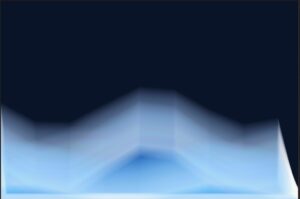
I fixed this by manually adding a final vertex at exactly width before closing the shape, ensuring the glow stayed consistent across the whole viewport.
Finally, I added a star field and a glowing moon. The moon uses the same SHM logic as the waves. Its outer glow pulses using a sin() function, making it look like it’s breathing or shining through a thin layer of haze.
Highlight
I am particularly proud of the Layered Glow Logic. It’s a simple loop, but it completely transforms the sketch from a flat math diagram into a piece of digital art. By jittering the y position slightly with i * 2, the glow “spreads” naturally.
// Layering loop for the glow effect
for (let i = 0; i < 30; i++) {
  stroke(255, 10);
  strokeWeight(0.5 + i * 0.8); // Thickens the stroke for outer "blur"

  let glowCol = color(red(this.col), green(this.col), blue(this.col), 15);
  fill(glowCol);

  beginShape();
  // ... vertex calculations ...
  let y = (this.yOffset + i * 2) + sin(currentAngle) * this.amplitude;
  vertex(x, y);
  // ...
  endShape(CLOSE);
}
Reflection and Future Ideas
This project taught me that nature in code doesn’t have to be random. By using pure trigonometry, I was able to simulate the rhythm of the ocean.
Future Ideas:
-
Perlin Noise Integration: I’d like to use noise to vary the amplitude so that “rogue waves” occasionally swell up.
-
Interactive Tides: Mapping the mouse position to the frequency of the waves, so moving the mouse makes the ocean “choppier.”
-
Twinkling Stars: Using a unique sine wave for every star so they shimmer at different frequencies.