Concept + Inspiration
This project was created in response to the assignment requirement to use Memo Akten’s exploration of Simple Harmonic Motion as a starting point. The goal was to understand how oscillation can function as a generative system rather than just a repetitive mechanical movement.
What I found most interesting in Memo Akten’s work is how simple sine functions can create complexity when layered together. Instead of treating harmonic motion as a physics simulation, I treated it as a compositional structure. I used multiple oscillators with different frequencies and phase shifts so that interference patterns would emerge naturally from the system.
Rather than keeping the study abstract, I translated the oscillatory behavior into a tidepool ecosystem. Each anemone is driven by overlapping harmonic functions that simulate tidal pull, organic sway, and micro-movements within the tentacles. A slower oscillator controls the bloom intensity, which creates a bioluminescent effect that feels ecological instead of mechanical.

I was mainly inspired by their bioluminescence and the way they sway so beautifully in the water, this is the image the drew the majority of the inspiration and what I’ve tried to mimic. However when I was done, I realized that this looks like the small lights in the new near by gas station “the hub”, makes me wonder if the inspo was more subconscious??
Code I Am Particularly Proud Of
One section of code I am particularly proud of is the multi-layer harmonic interference that drives the tentacle motion:
// I used AI to help achieve this :)
let oscA = sin(this.t * 1.55 + p);
let oscB = sin(this.t * 0.92 + p * 0.7 + this.phase);
let oscC = sin(this.t * 0.45 + p * 1.9);

let sway = (0.75 * oscA + 0.45 * oscB + 0.25 * oscC + this.current) * 0.65;
I used AI to help refine this blending logic. My intention was to create layered oscillation instead of a single sine-driven movement. The AI-assisted refinement helped structure the interference in a way that felt balanced without becoming chaotic.
This section is important to me because it shifts the system from predictable motion to something that feels organic. By combining oscillators with different frequencies and phase relationships, the movement becomes more ecological and less mechanical while still remaining mathematically grounded in Simple Harmonic Motion.
Milestones and Challenges
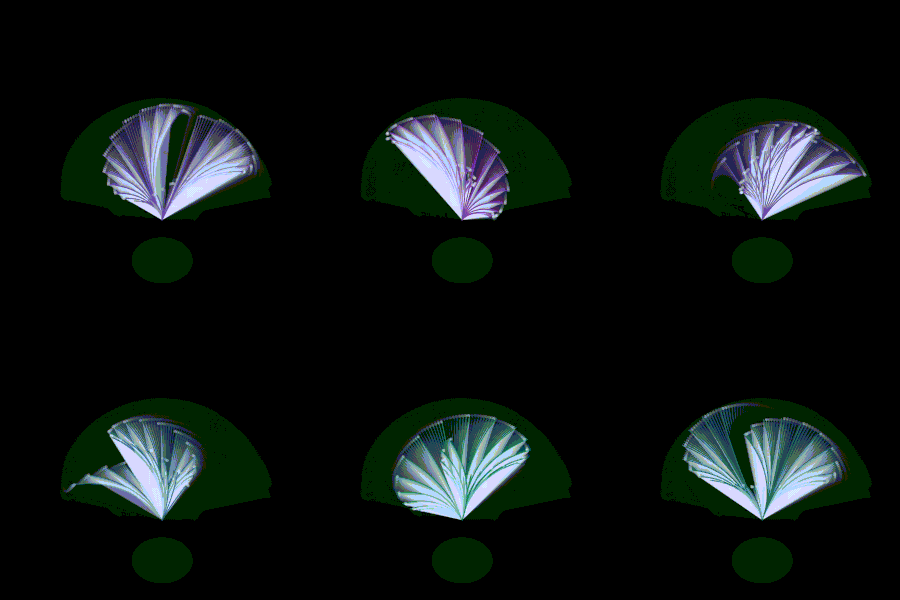
The first milestone was building a single anemone driven by one primary harmonic function. The focus at this stage was verifying that the tentacle sway behaved consistently and that amplitude, frequency, and phase shifts were functioning correctly.
Challenge: The motion initially felt mechanical and repetitive. With only one oscillator driving the movement, the behavior was too predictable and visually flat. This prototype helped me understand the limitations of a single harmonic source.
[gif to be added but the upload time is sooooo looooooonnnnggg :/]
instead here is a video:
The second milestone introduced multiple oscillators and expanded the system into a grid of anemones. This is where interference patterns began to emerge. I layered harmonic functions with different frequencies and phase offsets to create more complex sway.
Challenge: Balancing complexity without losing control. When too many oscillators were layered equally, the movement became chaotic. I had to adjust weight values so the system felt organic rather than noisy.
This stage also introduced the idea of a global tide and a directional current controlled by mouse movement.
Reflection and Ideas for Future Work
Through this project, I began to understand how Simple Harmonic Motion can function as a structural system rather than just a visual effect. Layering oscillators changed the behavior significantly, and small adjustments in frequency and phase created noticeable shifts in organic quality. The process reinforced how sensitive generative systems are to parameter balance.
One of the main insights was that complexity does not require complicated formulas. It requires intentional relationships between simple ones. When I reduced or reweighted oscillators, the motion became more coherent. When I over-layered them, the system lost clarity. This balance became central to the final result.
For future development, I would like to explore local interaction between anemones instead of having them behave independently. Introducing neighbor-based influence could allow wave propagation across the field. I am also interested in integrating audio input so harmonic frequencies respond dynamically to sound.
Finally, I would experiment with scaling the system for projection or installation, where viewer proximity could influence tide intensity or bloom cycles. Expanding the system spatially would shift it from a screen-based study into an environmental experience.