Concept
This project began with Abu Dhabi.
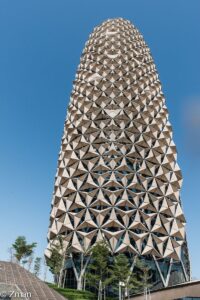
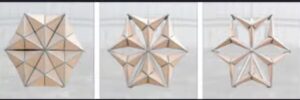
More specifically, it began with the building everyone calls the “Pineapple Building,” formally the Aldar Headquarters Building. Growing up in the UAE, I have always been surrounded by architecture that feels sculptural, patterned, and repetitive. What fascinates me about this building is not just its circular form, but its structural skin. It feels cellular. Layered. Alive.
Our class is about nature. At first, I struggled with how to connect Abu Dhabi’s hyper-urban identity to natural systems. Then I began thinking about cities as organisms.
Cities breathe.T hey pulse. They expand and contract.
That is where Simple Harmonic Motion came in.
Inspired by Memo Akten’s approach to translating natural systems into generative code, I wanted to build something that felt architectural but behaved like a living surface. Instead of simulating water, particles, or gravity, I decided to simulate a kinetic façade an aperture system that opens and closes like breathing cells across a city skin.
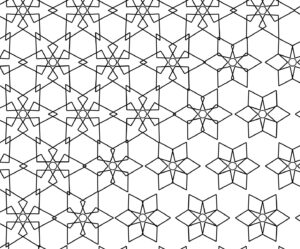
The triangular repetition of the Pineapple Building translated into a 6-fold radial aperture. Each module behaves like a mechanical petal system. When tiled together, they form a shifting urban membrane.
The result is not a literal copy of Abu Dhabi architecture, but a computational abstraction of its rhythm.
Code Highlight
One piece of code I am particularly proud of is the phase variation across the grid. At first, all modules were opening and closing at the same time, which felt flat and mechanical in a static way.
Introducing a spatial phase shift changed everything:
Instead of synchronized movement, the surface now moves like a wave. It feels less like a digital animation and more like a living field.
I also implemented easing to make the motion linger at the open and closed states:
This small adjustment made the motion feel architectural rather than purely mathematical.
EMBEDED SKETCH
Milestones and Challenges
Milestone 1: Building a Stable Radial System
The first step was creating a single aperture module. I constructed six evenly spaced angles:
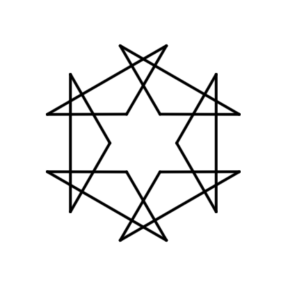
This established rotational symmetry. However, early attempts resulted in uneven overlaps and distorted petal geometry. The relationship between the inner hub radius, hinge radius, and outer tip radius required several rounds of trial and error.
Too much spread caused the petals to disconnect.
Too little spread made the motion invisible.
Balancing geometry and movement became the central challenge.
Milestone 2: Introducing Simple Harmonic Motion
To simulate breathing, I introduced a sine-based oscillation:
This normalized the motion between 0 and 1. However, pure sine motion felt abrupt at the extremes. It lacked the softness of organic motion. That led to introducing easing to create a smoother open-close rhythm.
This was my first real “nature” moment. I realized that nature is rarely linear. Even harmonic systems have softness.
Milestone 3: Scaling to an Urban Surface
Once the single module felt stable, I tiled it into a staggered grid:
The offset grid created density similar to a façade or cellular membrane.
The biggest challenge here was visual noise. When too many modules moved in sync, the surface felt static. When phase variation was too extreme, it became chaotic. Finding the right coefficients for the phase shift required repeated adjustment and testing.
This stage transformed the project from an object into an environment.
Reflection
I am in AW in what I can create in a week and teach myself….
What I learned from this project is that nature does not only exist in forests or oceans. It exists in systems. It exists in repetition. It exists in oscillation.
Abu Dhabi, often perceived as artificial or hyper-constructed, actually contains its own form of organic logic. Through coding, I translated that logic into a living digital surface.
This project allowed me to think about cities as breathing entities. Architecture as skin. Code as biology.
Future Improvements
Moving forward, I would like to:
-
Introduce mouse interaction so the “city” responds to proximity.
-
Incorporate particle systems inspired by Nature of Code Chapter 4.
-
Experiment with light and shadow instead of line-only rendering.
-
Translate the system into a physical fabrication prototype, possibly laser-cut layered acrylic panels.
I am especially interested in expanding this into a responsive façade simulation, where environmental data could drive the oscillation.