
Concept
When looking at Memo Akten’s work there was one piece that really took my attention. It was the “Simple Harmonic Motion #12 (2015)”. This although seemingly simple work with people hitting drums with their flashlight really caught my attention by the way it was done with playing with the lights and having all the actors “controlled by the computer”. So I decided that this is the perfect piece to somehow try to recreate in a similar way in p5.
Process
To begin with i first made the “map”. I decided to go with a “stage” looking design to fit the theme so to create something that fits what I imagined I made a completely black background with gray boxes to indicate stages where the people could move.

After it was time to create the performers. I created a performer class where I could create each of the human like performers that would move around the screen. I also decided to give them hands to give them some personality.
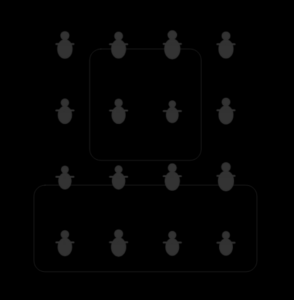
At first I experimented with random timing for movements, but this did not feel intentional or rhythmic. The animation looked chaotic rather than composed. To fix this, I replaced random triggers with sine wave oscillators, meaning that every action was driven by harmonic motion instead of randomness.
let g = (sin(frameCount * 0.02 + this.pid * 0.7) + 1) * 0.5;
this.onStage = g > 0.65;

let a = (sin(frameCount * 0.05 + this.pid) + 1) * 0.5;
this.armTarget = a > 0.75 ? 1 : 0;
After motion was working, I implemented the spotlight effect. Rather than drawing a single circle of light, I layered multiple translucent ellipses. This creates a gradient glow that visually resembles stage lighting and feels more organic than a flat shape.
The final step was adding sound. Each time a performer raises their arms while in the spotlight, a drum sound is triggered. I detect this moment by checking for a transition from arms-down to arms-up. This event-based logic ensures the sound only plays at meaningful moments instead of continuously.
Code Highlight
The proudest part of my project was definitely the movement.
let g = (sin(frameCount * 0.02 + this.pid * 0.7) + 1) * 0.5;
this.onStage = g > 0.65;

let a = (sin(frameCount * 0.05 + this.pid) + 1) * 0.5;
this.armTarget = a > 0.75 ? 1 : 0;
I am particularly proud of this part because it captures the entire conceptual idea in just a few lines of code. Instead of manually controlling each performer or assigning scripted movements, each performer is moved by a sine wave with a slightly different phase offset. This means every performer follows the same rule but behaves differently over time.
Future Improvements
If I were to continue working on this project I would maybe like to add some interactivity into it. At this point in time I am not sure how interactivity would work on this project and in what sense it could be implemented so I would love some suggestions. I would also maybe work a bit on visuals, but overall I am really happy with the final project.