Concept
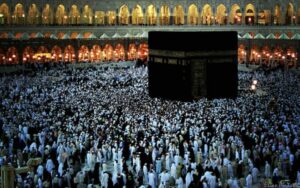
reference: https://muslimmatters.org/2012/11/15/ten-things-you-didnt-know-about-the-kaaba/
My concept for the flocking system is inspired by the sacred ritual of Umrah. I wanted to explore flocking in a different way where movement is not random or purely emergent, but organized around a central point. In Umrah, Muslims perform a ritual in which they circle the Kaaba seven times. I was interested in translating this idea into a computational system, where agents revolve around a central structure. In this project, I aimed to reflect that circular, collective movement in an abstract and respectful way, without directly representing people. Instead, I used simplified forms to suggest a crowd while keeping the focus on motion and spatial relationships. My visual inspiration also comes from a drawing of the Kaaba displayed in the art center, located beside the lift on the right side. Although I do not have an image of it, the composition and presence of that piece influenced how I approached the central structure in my work.
A highlight of some code
orbitForce() {
let center = createVector(width / 2, height / 2);
let radial = p5.Vector.sub(this.pos, center);

if (radial.mag() === 0) return createVector(0, 0);

// convert radial direction into circular motion
let tangent = createVector(-radial.y, radial.x);
tangent.normalize();
tangent.mult(this.maxSpeed);

let steering = p5.Vector.sub(tangent, this.vel);
steering.limit(this.maxForce * 1.3);
return steering;
}
One part of the code I am particularly proud of is the orbit behavior. Instead of having agents move randomly or only react to nearby neighbors, I introduced a force that converts their position relative to the center into a tangential direction. This allows the agents to move in a circular path around the central square. This was important to my concept, as it transforms a typical flocking system into a structured, collective movement organized around a focal point.
Sketch
Milestone
https://youtube.com/shorts/Aij4knx0vcE?feature=share
- Here I was exploring how a flocking system could revolve around a central structure. I combined basic flocking behaviors with a simple orbit force to create circular movement. At this stage, the system is intentionally minimal, focusing on testing the core idea before adding complexity like time-based changes or refined visuals.
https://youtube.com/shorts/de8Qt2qCW88?feature=share
- In this video, I wanted to highlight the interaction of dragging the mouse to generate agents in the system. As more agents are added, the movement becomes slower and more dense. This reflects how, in Umrah, movement naturally slows down as the crowd becomes more crowded, creating a more compressed and collective flow.
Challenge
One of the main challenges in this project was balancing control and emergence. While flocking systems are naturally unpredictable, I needed the agents to consistently move in a circular path around the central square without losing the organic quality of the motion. Another challenge was achieving the right level of simplicity in the visuals, ensuring the system remained clear and readable without becoming overly complex or decorative.
Reflection and ideas for future work or improvements
I developed a better understanding of how simple rules can produce complex and meaningful collective behavior. I learned how to balance structure and emergence. For future work, I would explore making the movement more varied and responsive, such as introducing different types of agents or layering multiple rings of circulation.
Nice sketch! I love the painting you’re referring to from the arts center. I also always thought it looked like the Kaaba, and your sketch really reminds me of its minimalistic, modern design. I suggest you make the walkers move in the opposite direction (counter-clockwise rather than clockwise) to mimic the real pilgrimage more accurately. Also, if you want to make it even more realistic, you can make them avoid going through each other with collision avoidance.
Really cool! I like how it’s a flocking system and a revolving system at the same time.
This is such a strong concept honestly. I really liked how you took flocking and pushed it away from something random into something that carries meaning and intention. Basing it on Umrah makes the system feel much more grounded, and I think you handled that in a very respectful way by keeping it abstract and focusing on movement, rhythm, and space rather than directly representing people.
I also think the orbit force is one of the strongest parts of the project. It is smart technically, but it also really supports the concept. The fact that the agents are not just flocking normally, but are being guided into this circular collective motion around the center, makes the piece feel specific and well thought out. It gives the system its own identity.
This project is so meaningful Afra. I really love how you took a standard flocking system and gave it so much purpose by basing it on the ritual of Umrah. The way you used an orbit force to guide the agents into a collective circular motion instead of just letting them move randomly is a really smart technical choice that perfectly fits your concept. It is also impressive how the movement naturally slows down as the crowd gets denser just like in real life. You handled the abstraction very respectfully and the connection to the artwork in the arts center makes it feel even more personal. Amazing work on this.