Concept + References
I didn’t want to make a “flocking simulation” in the traditional sense. I wanted something that feels alive but also unstable. Something that holds itself together, then loses control, then collapses.
The system is structured as a looped lifecycle with four distinct phases: organism, boil, shockwave, spores
Each phase shifts not just motion, but also energy, density, and emotional tone. It’s less about birds flocking and more about a body going through pressure, rupture, and release.
I was really inspired by Ryoichi Kurokawa’s work, especially how he uses temporal disruption instead of just spatial complexity. His visuals feel like they’re glitching in time, not just moving fast.
I was also thinking about Robert Hodgin’s particle systems, especially how they feel dense and intentional rather than random. His work made me care more about composition, not just behavior.
So instead of just coding movement, I focused on how particles occupy space, how density creates visual tension, how color and blending create a kind of “liquid light”
Highlight of Code I’m Proud Of
I think the strongest part of my system is how the phases are structured and how each one completely redefines the physics:
function getPhase(t) {
  if (t < 13000) return 'organism';
  if (t < 21000) return 'boil';
  if (t < 24000) return 'shockwave';
  return 'spores';
}
This simple structure lets the whole system evolve over time instead of staying static.
But what I’m most proud of is the shockwave phase. Instead of just pushing particles outward, I introduced a temporal glitch:
if (frameCount % 4 === 0) {
  this.vel.mult(0.1);
} else {
  let blastAngle = random(TWO_PI);
  let blast = p5.Vector.fromAngle(blastAngle).mult(5);
  this.acc.add(blast);
}
This creates a stuttering effect where particles freeze and explode intermittently, which feels much more chaotic and alive than a smooth explosion. It’s not just movement, it’s disruption.
Embedded Sketch
Milestones
Milestone 1: The Basic Flocking Organism
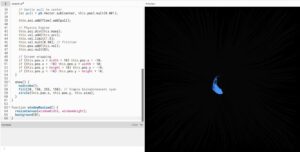
Before I could build a complex timeline, I needed a base system. I started by creating 1,000 particles and using Perlin noise to guide their movement. I added a gentle pull toward the center of the screen so they wouldn’t just scatter. I also drew a low-opacity background every frame to create soft motion trails.
Milestone 2: Introducing the Time Machine
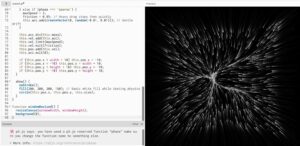
Once I had my organism floating nicely, I wanted the environment to change over time. I created a 30-second loop using millis() and wrote a getPhase() function to track time. I then updated my particle’s physics engine to react completely differently depending on whether it was in the organism, boil, shockwave, or spores phase.
Milestone 3: The Final Visuals and Additive Blending
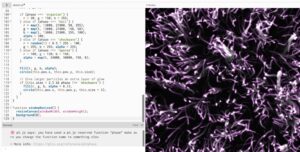
The physics were working perfectly, but it felt a little stiff visually. For my final step, I mapped specific colors to the timeline so the sketch would transition from cool cyan to boiling orange, into blinding white sparks, and fade out into grey dust.
To give it that volumetric, glowing liquid feel, I implemented blendMode(ADD) in the draw loop, and I instructed larger particles to draw a secondary, highly transparent circle behind them.
Reflection
I think what worked best in this piece is the sense of tension and release.
The “organism” phase feels calm but slightly eerie, like something is forming. Then the “boil” phase starts introducing discomfort and instability. The “shockwave” is the breaking point. And the “spores” phase feels like exhaustion, like everything just gives up and drifts.
I also paid a lot of attention to:
- blending modes (ADD made everything feel volumetric and glowing)
- motion blur through background fading
- particle size variation to create depth
I didn’t want it to look like dots moving. I wanted it to feel like matter.
Future Improvements
If I were to push this further, I would:
- Make transitions between phases more gradual instead of abrupt
- Introduce sound and sync the phases to audio (especially inspired by Kurokawa)
- Add interaction, maybe letting the mouse disturb the system
- Experiment with depth or layering to make it feel even more spatial
- Refine color transitions so they feel less mapped and more emergent
Also, I think there’s potential to push the narrative more. Right now it suggests a lifecycle, but it could become something more specific or symbolic.
Final Thoughts
This project made me realize that generative systems don’t need to just simulate nature. They can simulate states, emotions, or conditions.
It’s not about particles.
It’s about what they feel like together.
This doesn’t feel like a simulation, it feels like something actually happening. The arc from organism to spores is genuinely emotional, by the time you hit spores it feels exhausted in the best way.
I think this is a really interesting take on flocking, especially how you focused on phases instead of a single continuous behavior.
The stuttering effect of the shockwave phase makes it feel more disruptive and intentional rather than just a smooth explosion. I also liked the visuals, especially the additive blending and trails, which make everything feel more dense and layered.
My only suggestion would be to maybe add some user interactivity to the project. Although I love how it looks visually and how it feels, I would also like to have the ability to control it or any part of it somehow. But I still believe the project works well even without user interaction. Overall great project!