Concept
My project explores how cellular automata can be used to generate patterns inspired by Sadu weaving, a traditional textile practice found in the UAE and across the Gulf region. Sadu textiles are known for their repeated geometric motifs, strong symmetry, and earthy color palettes such as red, cream, brown, and black. I was inspired by the woven texture, rhythm, and repetition seen in Sadu fabrics. I wanted to combine traditional visual culture with digital generative design by allowing each new row of cells to behave like a woven textile row.

Sketch
Code Highlight
function applyRule(a, b, c) {

  let index = parseInt("" + a + b + c, 2);

  return ruleset[7 - index];

}
I am proud of this section because it is the core of the cellular automata system. It takes the left, center, and right neighboring cells, converts them into a binary pattern, and uses that pattern to determine the next state.
Challenges
One challenge was understanding how the rulesets worked in cellular automata. At first, it was confusing how three neighboring cells could control the next generation. I had to experiment with different rules such as Rule 30 and Rule 90 to understand how each one changed the visual output.
Milestones
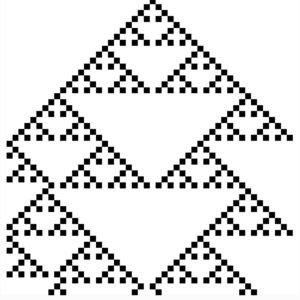
- This was the beginning stage of the project. I focused on understanding the basic logic of cellular automata using a simple black-and-white version. Each row was generated from the row above it using Rule 90.
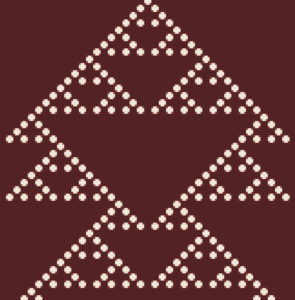
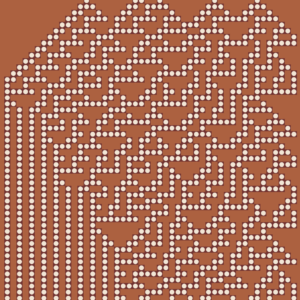
- In this stage, I began developing the visual side of the project. I introduced color inspired by Sadu weaving, using earthy reds, creams, and warm tones. I also experimented with different shapes and randomized starting seeds. This milestone helped connect the technical system to my UAE cultural inspiration.
Reflection & Future Improvements
This project helped me understand how simple coding rules can create complex and visually interesting patterns. I enjoyed exploring how cellular automata can be used not only as a mathematical system, but also as a creative tool inspired by culture and design. Connecting the project to Sadu weaving made the process more meaningful and gave the patterns a stronger identity.
If I continue developing this project, I would like to improve the motifs so they look closer to real woven textile patterns. I would also experiment with more UAE-inspired color palettes, smoother animations, and additional rulesets to create a wider variety of outcomes. In the future, I would also like to explore using 2D cellular automata or projecting the patterns onto fabric or physical materials.
I actually really like this, it’s clear and the idea comes through well. The Sadu inspiration is strong and honestly makes the whole project feel more grounded and you. I like how you treated each row almost like a woven decision, that connection is really nice.
The code highlight is solid too, that function is doing all the heavy lifting and you explained it clearly without overcomplicating it. Same with the challenges, it feels real and not forced, like you actually went through the confusion and figured it out.
I love this idea Afra!! good job on translating it into code, when I first clicked on your post I gave your post a quick scroll and immediately could tell the intention behind your sketch. I can really see this in a curatorial theme of Emirati culture.
It would be amazing to see other colors like red, black, white and green included in the sketch especially in the background, I feel like that would further solidify the intent behind what the sketch is supposed to represent. Great job!