Concept
For this assignment, I wanted to explore something that felt truly organic. My sketch is built on a mathematical model called Reaction-Diffusion (specifically the Gray-Scott model).
The concept mimics how two virtual liquids – Chemical A (the environment) and Chemical B (the organism) – interact over time. Chemical B eats Chemical A to reproduce, while also slowly dying off. This eternal tug-of-war is actually the exact same math that dictates how real-life animals get their spots and stripes, or how corals branch out! That was what inspired me to recreate this in a sketch.
Visually, I wanted the sketch to feel like you were peering into a dark ocean trench and watching neon coral grow in real-time. Just something about oceans.
Sketch
Milestones and Challeneges
Reaction-Diffusion is notoriously heavy. It requires calculating complex math for every single pixel, multiple times per frame. My initial versions of this sketch were incredibly slow and completely hung my browser.
I had to rethink how the data was stored. I moved away from standard 2D arrays and rewrote the grid using 1D Float32Arrays. This stores the data in a flat, highly optimized memory space. I also added bitwise operations for fast multiplication to keep the framerate high enough to actually watch the coral grow.
Getting the bioluminescent aesthetic right was also trickier than I expected. When I first tried to separate the glowing coral from a solid dark background, I used a hard cutoff (e.g. if the chemical value is above X, paint the background). Because the simulation uses continuous floating-point math, this resulted in ugly, pixelated ghost borders where the shapes used to be.
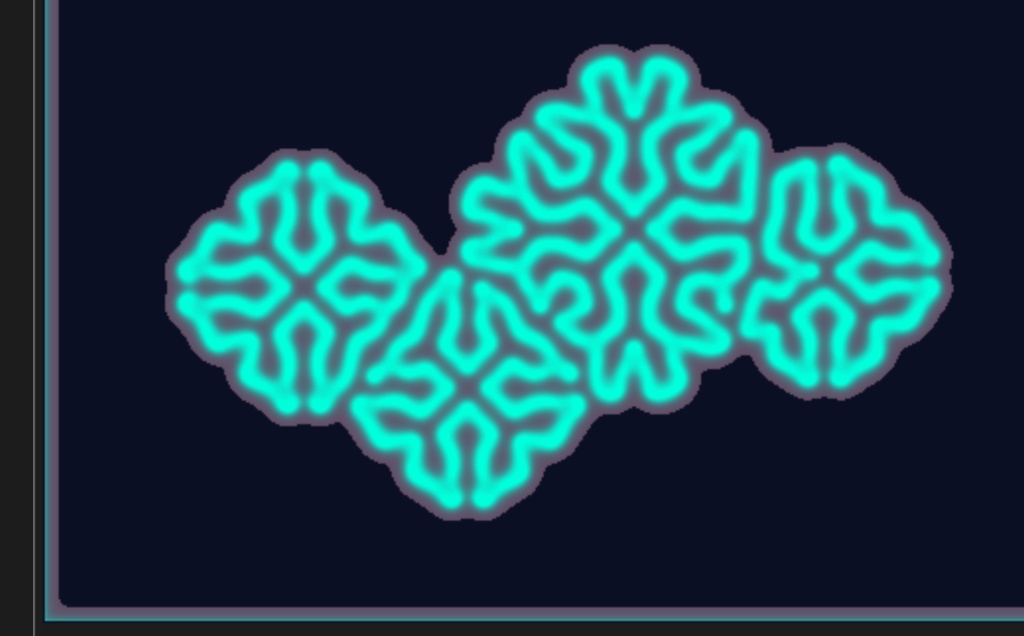
I went back to basics and removed the hard if/else statements. Instead, I used mathematical ratios to smoothly blend the colors based purely on the exact concentration of the chemicals.
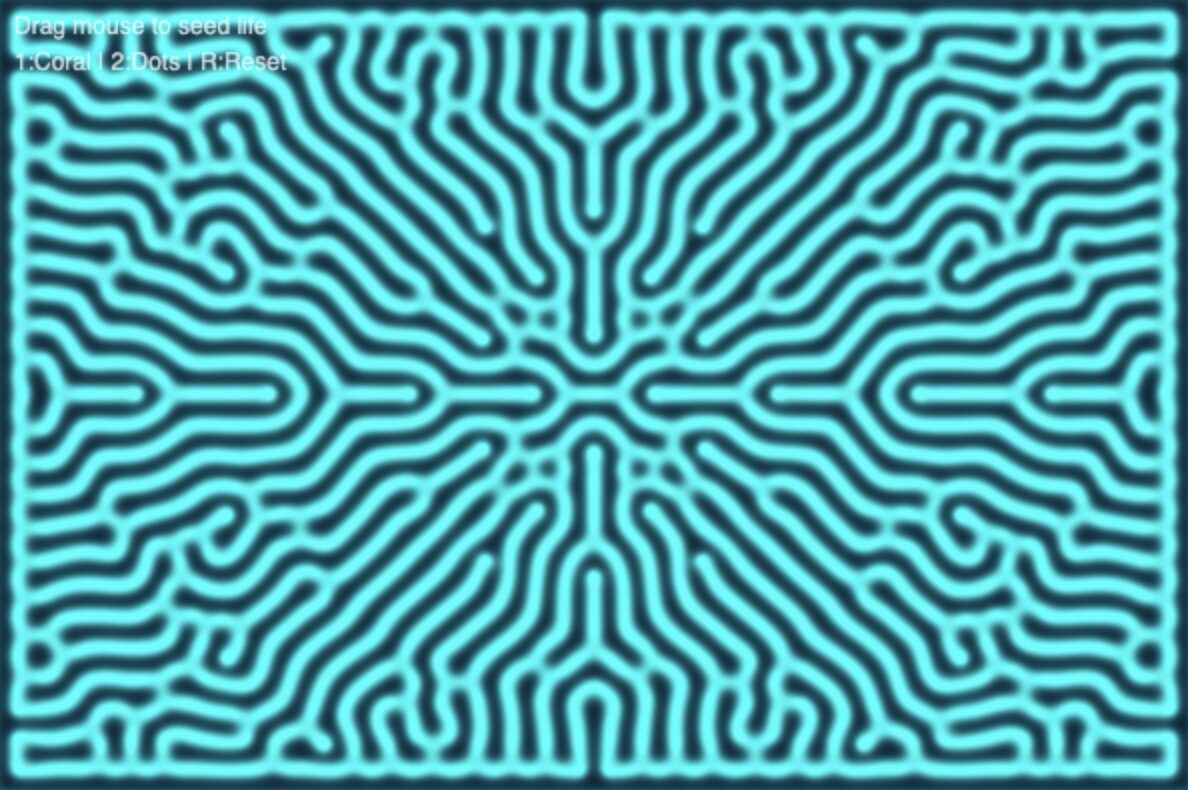
The patterns are completely driven by two parameters: the Feed Rate (how fast Chemical A is added) and the Kill Rate (how fast Chemical B dies). Experimenting with these numbers yields wildly different shapes. I eventually curated two distinct modes for the final sketch: a classic branching “Coral” mode and a struggling, isolated “Dots” mode.
Reflection & Future Work
This project pushed my understanding of performance optimization in JavaScript. Moving from simple binary states (1s and 0s) to a Continuous Cellular Automata (floating-point numbers) completely changes how you have to handle memory and rendering in p5.js.
If I were to take this further, the next logical step would be moving the math out of the CPU entirely and rewriting it in WebGL (Shaders). That would allow the simulation to run at fullscreen resolution instantly. I’d also love to introduce an interactive element where the mouse acts as a “repellent” to the coral, forcing it to grow around your cursor.
Look into the concept of slime molds, it looks exactly like your project, I see this as a Biotech sketch feel